Every customer works through a series of decisions before arriving at a final one. The route from first contact to the purchase decision and on to lasting loyalty is what the trade calls the customer journey. For that journey to reach its destination at all, it needs the right content along the way.

You can track precisely what your customers take an interest in and which clicks they make, yet the paths that emerge are as individual as the customers themselves. The challenge lies in delivering the right content at every stop.
Content and user behaviour
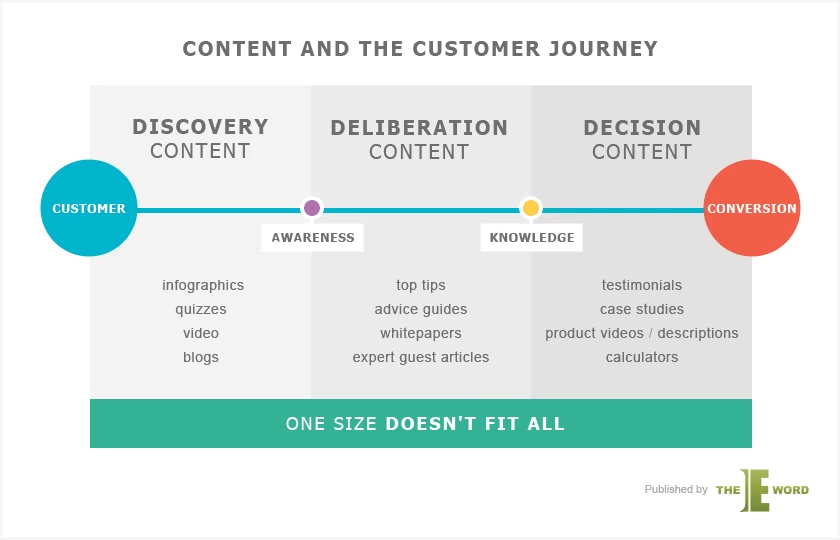
Producing content for the customer journey means placing the right content at the right time in the right place. To manage that, the behaviour of your prospects and customers has to be analysed closely. Only then can their route be traced, and only then can you draw conclusions about which content is of particular relevance. On that basis you can build a content marketing strategy and consistently create content that picks people up exactly where they currently stand.
Keeping touchpoints in view
In the course of every customer journey there are points at which the user interacts with your content in some way. That interaction may be reading a text, watching a video, filling in a form or using an application. These points are called touchpoints, and they deserve particular attention, because this is where the user makes decisions.
“Only if the content is convincing, useful and helpful will the user stay with you and carry on the journey.”
The demands you place on that content should be correspondingly high. It should offer the user a solution on the one hand and convey a positive picture of your company or your brand on the other. Not all content suits every customer equally well, which is why it is essential to analyse your audience beforehand.
“Only when you know as precisely as possible who the content is being created for can you hope to spark lasting interest.”
The central questions therefore aim to establish who exactly belongs to your audience and what that audience is really interested in. Beyond that, it matters when and under which circumstances members of that audience take an interest in particular content, and through which channel it should reach them. Touchpoints do not sit on your own website alone: they sit on social media as well.
The customer journey as a model: moments of truth
The customer journey can be split into individual phases, which makes it straightforward to set out as a diagram. Several models have emerged over the years for exactly that purpose. The best known of them was developed by Procter & Gamble, is called Moments of Truth and divides the customer journey into three phases:
- Stimulus
- First Moment of Truth
- Second Moment of Truth
Stimulus is the phase in which the potential customer’s attention is caught. That may be a classic television advert, a banner on a website or an influencer’s video. Once the stimulus has done its job, the customer decides in favour of the brand or of buying the product, and that is the First Moment of Truth. Consumption follows, during which the customer forms their own experience of the product — the Second Moment of Truth in this model.
The consumer therefore checks whether the quality the company promised is actually delivered. If they speak about that experience, it is known as the Third Moment of Truth. The message can go directly to other consumers or indirectly as a rating, on social media for instance.
The seven-stage customer journey model
The seven-stage model gives a more detailed picture of the customer journey. Here the journey breaks down into the following phases:
- Pre-awareness
- Awareness
- Consideration
- Preference
- Purchase
- After-sale
- Loyalty
In the pre-awareness phase the customer has no sense of having a problem and therefore no reason to act. At this stage it is difficult to catch their attention with content at all. Awareness of the problem first has to be created by the content itself, which not infrequently calls for psychological devices or an emotional appeal.
Only in the awareness phase does an event occur that makes action necessary. At this stage of the customer journey the user looks for information that might help with the problem and offer a solution. The content that meets prospects here has to be just as solution-oriented. What counts is presenting your offer with the right content in the right place.
The consideration phase is already about a concrete need. The consumer has a clear idea of the kind of solution they are looking for. The problem itself is no longer the focus; the product meant to remedy it is. Your content now has to communicate that you offer such a solution, and this is the first point at which product-related advertising is justified.
The preference phase is about choosing between the various offers of a solution. The consumer weighs up which of the products on offer comes closest to solving the problem. Product-related advertising and tests are the content that can steer the decision towards your own offer at this point.
Once the decision has been made, the customer journey reaches the purchase phase. Here it is important to make things as easy as you can, so that no formalities stand between the customer and the purchase. The after-sale phase is about keeping that customer. Product quality and service now come first, and the content the customer turns to has to be just as service-oriented. If the customer is happy with the product, they enter the loyalty phase. In the best case they are so taken with it that they want to pass the experience on: they recommend the offer to others, leave ratings or write their own reviews, which in turn can become content in someone else’s customer journey.
The right content along the customer journey brings you more customers
These models give you something to steer by when you create the ideal content for your customer personas and your customer journey. The more specifically the content matches the target customer and their current position in the journey, the greater the success. Customers can be won deliberately and effectively this way.