Case studies can be an effective way to show what you have achieved and to strengthen your lead generation. But how should a reference be built so that your company actually benefits from it? Here is how simple and effective that can be.

What a case study actually is
A case study sets out what a company delivered and achieved on a particular project. It usually covers that project in full, from the first concept through to completion, and it highlights the professional approach taken and the results the work produced.
What matters is that the study is written so that someone outside the field can follow it without effort. It also has to catch interest and hold it. That is a balancing act, because plenty of case studies lose the reader in long explanations and technical detail.
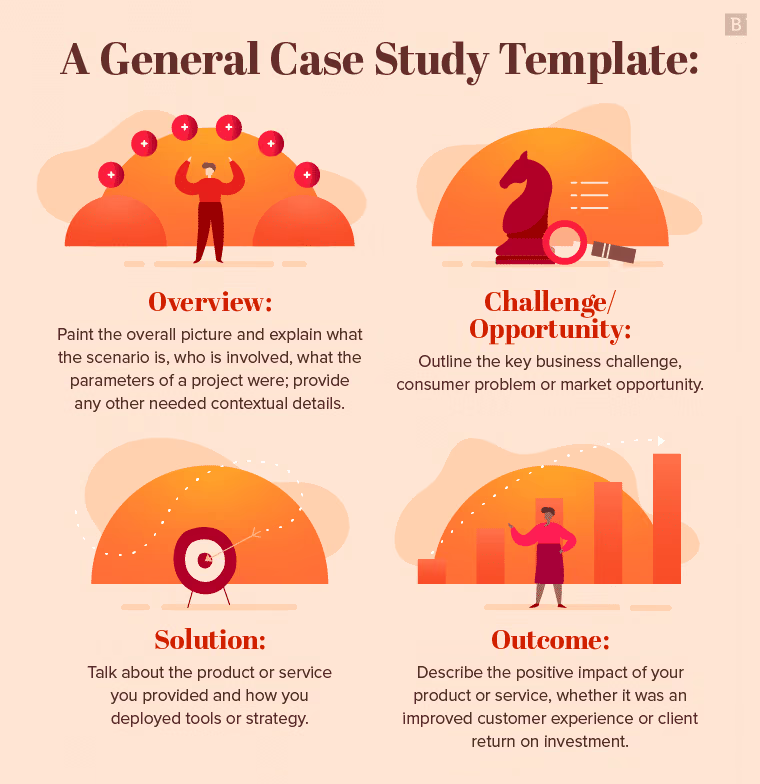
A case study for lead generation needs more than text
Few prospects want to work through a solid block of text to find out how successful a company is. So a case study should bring in several kinds of media.
Images and diagrams help people take the content in and lower the barrier to entry. Video makes complex connections much easier to explain. Short paragraphs and content that is easy to consume are what work here.
Why case studies matter to prospective customers
So why do case studies work so well for lead generation? Because the results do not just impress, they convince. Many customers distrust marketing on its own and assume that companies are not entirely honest about the way they present themselves. A case study is different: it usually presents verifiable facts, and the customer could check them with a little research.
“Trust on the part of the prospective customer is decisive in lead generation.”
Presenting your success to the audience you want
For lead generation to work in a meaningful, targeted way, both the kind of case study and the way you present it have to fit the audience you are aiming at. Content for B2C customers has to be presented differently from content for a B2B readership.
Take an example: you want to present complex technical services as a success for your company. With B2B customers from a similar field you can use the specialist vocabulary in the study and will barely need to explain it. With B2B customers from another field it is a different matter. There the reference has to be written so that the reader is fully informed without reaching for a dictionary.
In the B2C segment this is often harder still, because many case studies have to be broken into much smaller steps for the knowledge to carry across. Only a form and presentation that fit will secure lead generation.
Always think about what the reader gets out of it
It is of course pleasant for a company to present its own success. But do not lose sight of the point: showing your own success is not enough to generate leads. The value for the reader or consumer has to be made clear.
So a case study should always set out what the client company gained in that particular case. Better revenue, leads generated, more visitors to the site? All of that belongs in the study as well, recorded and clearly communicated.
“Used this way, case studies work for lead generation and convince customers and buyers.”
Use case studies across several channels
Case studies naturally have to be presented well on the company website. But for anyone to find them, you need to use your various marketing channels to bring more visitors to those pages.
Social networks in particular have proved highly effective for case studies. A short extract and a few well-communicated facts are often enough to persuade someone to visit. Think about the media mix here too, and bring in interesting diagrams or video.