Successful companies leave nothing to chance in marketing and sales, and every deal counts. Structured lead and opportunity management creates the potential to maximise both the number of deals you close and your revenue. The quality of your lead management has a decisive influence on when a lead is recognised as an opportunity and worked on as a priority.

Opportunities and risks in opportunity management
Broadly speaking, an opportunity is a prospect who is very likely to be close to closing a deal. The aim of opportunity management is to sort sales qualified leads by how good the chance of a sale is and to prioritise the work accordingly. Behind that apparently simple task sit complex demands and real risks. A customer with a concrete intention to buy who is dealt with too late does not feel valued, and in the worst case moves to a competitor. A lead that is recognised as an opportunity in good time, by contrast, will be impressed by the quality of your service and will buy your products and services feeling good about it. For that to happen, marketing and sales have to work together and plan their activities in step with each other.
The basis for success: effective lead management
Lead management comes before opportunity management and lays the foundation for future sales success. How long it takes, and which steps are needed to move a lead to a marketing qualified lead and finally to a sales qualified lead, differs from customer to customer. Winning leads and qualifying them are the tasks of lead management.
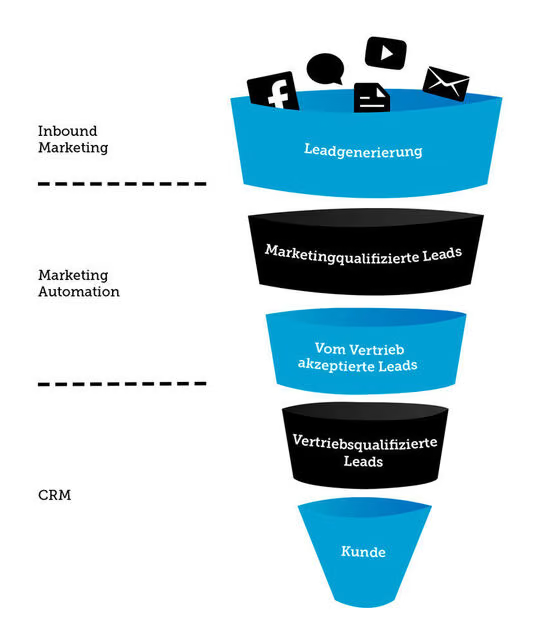
“Without highly professional and efficient lead management there is no opportunity management.”
Providing content that offers genuine value, and gathering relevant customer data and information as the customer journey progresses, is an essential precondition for having enough material to judge those probabilities. Every measure in lead management is aimed at winning the trust of prospects and preparing them for a successful conversion.
There is little point in handing leads over to sales while they are still at the marketing qualified lead stage. What matters far more is giving every lead the time it needs to reach a well-founded buying decision and genuinely become an opportunity.
Making the most of what your CRM knows
Your CRM helps you judge when a lead should be treated as an opportunity. Not every lead has the potential to become a customer. Efficient lead management lets you protect your resources, which means not putting unnecessary time and money into poor leads. Several models are available to give you a realistic assessment of the chances, for example the BANT model.
Questions worth asking in that assessment are:
- How large is the budget the lead has available?
- Are other decision-makers involved?
- How much support does the lead need?
- How long will it take until a deal is closed?
- What revenue could the lead generate?
- Is the lead already engaged with a competitor?
To judge each lead precisely, it is decisive that you have a single, consistent set of data to work from. All the data from every contact with a prospect has to be available to you in full. The quality of your data is therefore the foundation of sales success.
Give opportunities the priority they deserve
No company can afford to miss a potential customer in time and then lose them early in the sales process because they are dissatisfied. Both marketing and sales should set up specific, coordinated processes for opportunities that give the customer the essential information, show that they are valued, and produce results you can measure.
Successful opportunity management lets you manage your sales pipeline and forecast future revenue. It also makes wins visible to your team at an early stage. Recognising every opportunity matters if you want to reach and beat your revenue and sales targets. Consistent performance measurement, supported by your CRM, lets you improve opportunity management continuously and predict probabilities more accurately. Step by step you can improve your marketing and sales process and tailor it more closely to what your audiences need and expect.
Conclusion: better customer relationships through opportunity management
Customers who are looked after in line with their potential from the very start feel that they are in good hands. Lead management that works, followed smoothly by opportunity management, starts a customer relationship built on positive experience. Once a deal is closed, that gives you numerous starting points for reference marketing and further sales activity. Companies that rely on inbound marketing benefit in particular from the combination of lead management and opportunity management.