How the Google ranking is put together, and how websites are assessed, is essential knowledge for SEO. With “Page Experience”, a new Google ranking factor arriving in May 2021, the next big change is on its way. Under that term Google bundles several metrics that concern the technical build and the loading times of a page in particular — and they will matter a great deal to you from now on.

Now with a date: Page Experience from May 2021
Back in the summer of 2020 came the announcement that the “bundled signal” would soon become a ranking factor and would therefore have a decisive influence on the Google ranking. For a long time things then went quiet around Page Experience — according to Google partly because of the worldwide coronavirus pandemic. Now the starting date is fixed, and in May significant changes are coming your way.
What Page Experience is made of
The new Google ranking signal rests on a combination of seven metrics in total, three of which represent the so-called Core Web Vitals. The Core Web Vitals have been filling monitors in marketing departments for some time; they were first introduced in May 2020. They break down as follows:
- Loading time (Largest Contentful Paint)
- Interactivity (First Input Delay)
- Visual stability (Cumulative Layout Shift)
Together they are meant to assess the technical user-friendliness of a website. Think of them as a blueprint for what Google regards as best practice.
Page Experience combines those three metrics with four further criteria. They are:
- Compatibility with tablets and smartphones (mobile friendly)
- Quality of the code, particularly regarding efficiency and security (safe browsing)
- Use of HTTPS encryption, which ought to be standard already
- No intrusive interstitials
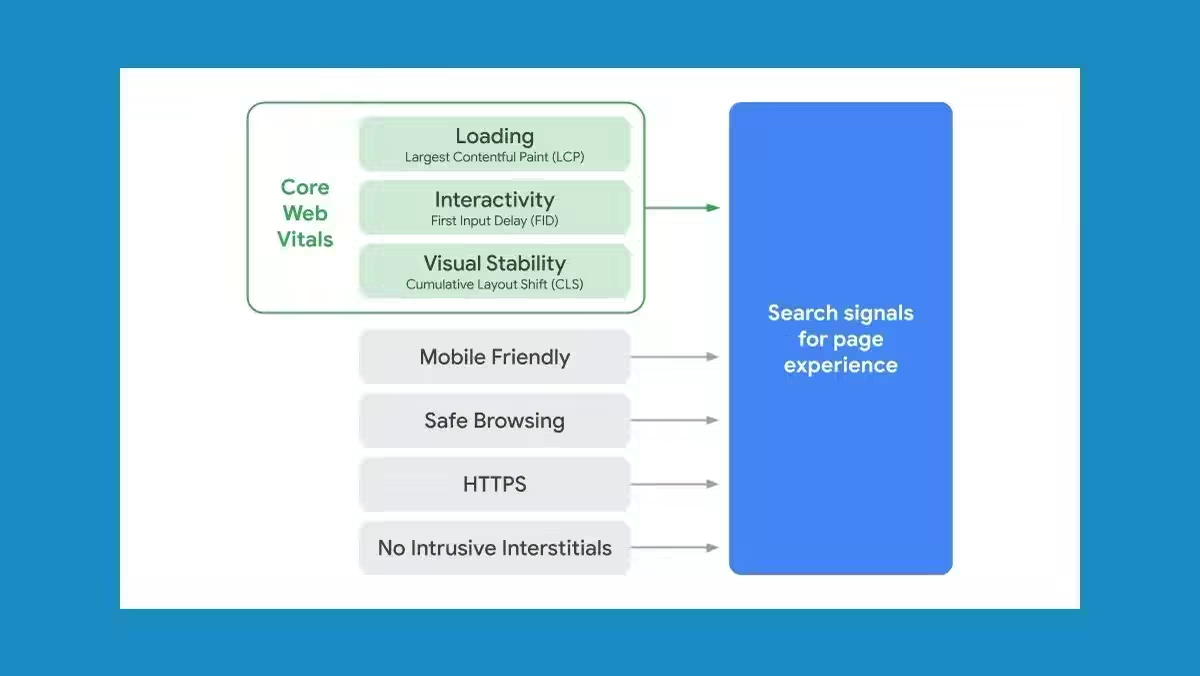
Looking at the seven metrics it becomes clear that Page Experience is not, strictly speaking, an entirely new ranking factor. It represents seven metrics that already feed into the Google ranking of your projects today. Given the bundling and the announcement, one may assume that all seven will play a larger role in the assessment than before.
Remember: the mobile friendliness of a website was already taken into account as “Mobilegeddon”, announced with great media effect under that catchy name. The same applied to HTTPS, which led to a general rethink across the internet. Google’s algorithm adjustments of yesterday shaped the future of tomorrow. Loading times, meanwhile, were re-weighted with the “Mobile Speed Update” among others.
What the individual Core Web Vitals metrics tell you
With many of the terms Google uses it is easy to work out which criteria they ultimately represent. Even so, terms like “Cumulative Layout Shift” are not necessarily familiar to many marketers and webmasters, for entirely understandable reasons. Here is what sits behind the new metrics — and how they help you set your projects up for the future.
Largest Contentful Paint (LCP): loading time
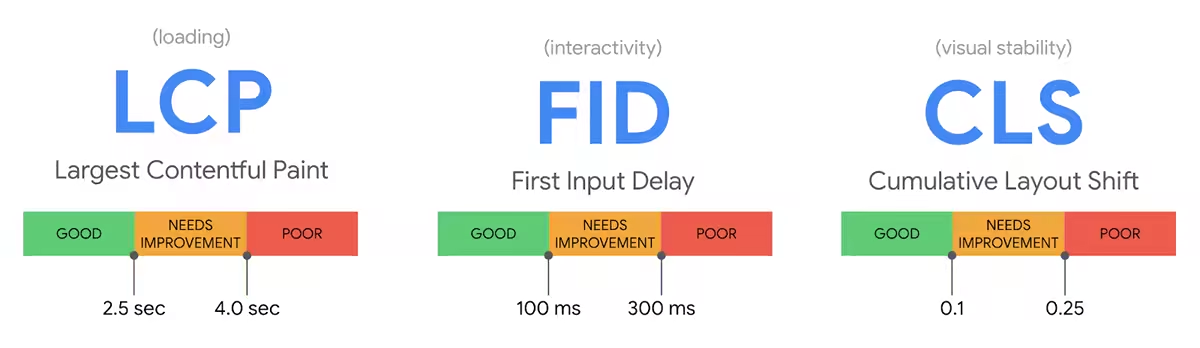
This measures the time that passes between opening the page and the primary content being fully loaded. Google regards values below 2.5 seconds as good; between 2.5 and 4 seconds there is room for improvement. Websites that take longer than 4 seconds to load their primary content risk being downgraded.
Cumulative Layout Shift (CLS): visual stability
Websites load step by step, even when the user does not notice it. In the worst case that means a user wants to click an element, the page is still loading, and the whole layout then shifts — so the click lands on an advertising banner instead, or nowhere at all. It is positive when the layout shifts little or not at all while loading. Google rates CLS values up to 0.1 as positive and anything above 0.25 as poor.
First Input Delay (FID): interactivity
FID indicates how much time passes between the user’s first interaction and the response of the browser and the page loaded in it. Good values are under 100 milliseconds; anything above 300 milliseconds gives solid grounds for improvement.
The other four metrics: familiar things that gain new meaning
Page Experience also picks up four long-familiar metrics. They are worth a closer look, because best-practice solutions today are often tomorrow’s standard.
Mobile friendly
This criterion represents how well a website is presented on mobile devices such as tablets or smartphones — both in terms of loading times and the arrangement of design elements.
Safe browsing
For a website to be assessed positively, Google expects it to use lean, efficient and clean code. Even though users do not come into direct contact with it, the code stands for the quality of the website and its backend.
HTTPS encryption
The small padlock in the browser’s address bar is by now familiar even to less technically minded users. HTTPS enables secure transmission between user and website and has long counted as an indispensable standard.
No intrusive interstitials
The term “interstitials” is not new, but it is not widely known either. This metric becomes clearer if you replace interstitials with “pop-ups”, because that is exactly what is meant. Disruptive pop-ups that block the view of the actual content are rated negatively by Google. Sometimes they cannot be avoided, for instance with regard to the GDPR and the cookie prompts that come with it. Advertising and the like, however, could lead to a poorer assessment.
Conclusion: the new metrics are not an obstacle, they are an opportunity
Page Experience is coming, and while it may not turn Google rankings on their head, it will definitely influence them. Many of the metrics it contains are taken into account already, but from now on with greater weight. In any case they all reflect what matters well beyond search engine rankings: laying the foundation for a positive user experience, so that your visitors come back again and again.