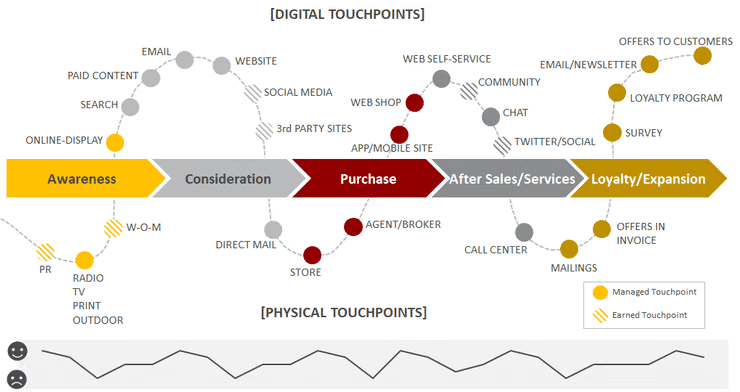
From the first contact to the final purchase decision, customers travel a path of their own — across websites, social media profiles and offline channels. If you want to accompany that path with marketing that lands, you have to understand it: which stages carry the decision, which points of contact exist, and where people drop out again. Following that path is what the customer journey on social media is for.

Why the customer journey matters
The customer journey serves to align and improve your marketing, and to understand the needs of your customers as fully as possible. What you observe is not limited to your own website or your social media profiles; it extends to behaviour at every direct and indirect touchpoint. A touchpoint can be your company website, a display banner, a tweet or a product photo on Instagram. Only once all of them are included can you capture and evaluate the customer’s decision-making journey almost in full.
“It tells you which phase to address customers in, and with which messages.”
The approach lets you trace and analyse the brand experience a customer has along the journey. From there you can address customers appropriately, support them and give their interactions a positive emotional charge. That in turn reduces churn.
The customer journey therefore presents the whole purchase decision process as a kind of journey. It begins with a need being created and ends with the final purchase decision — and beyond that with customer retention and support. For many prospective customers the journey now runs largely on social media, which is also where the first points of contact with the brand or the company occur. What matters is that the customer meets that point of contact while searching for specific information about their own question.
AIDA model: four phases to the purchase decision
The customer journey takes a holistic view, following the customer’s path from the first point of contact (touchpoint) with a product, a company or something similar through to the final purchase decision. That path is divided into phases based on the four-stage AIDA model. AIDA stands for:
- Attention
- Interest
- Desire
- Action
The first phase, Attention, describes the customer getting their bearings, and the first points of contact are often on social media in the form of ads. The phase can just as easily start with videos, images and text — how-to articles in blogs, forums and social networks — and set the research going. The transition to the specification phase, Interest, is fluid. Images on Pinterest or Instagram open up the range of alternatives available to someone searching for a particular kind of product.
Next comes the supplier selection phase. The customer is now looking for more detailed information in order to settle on a specific product. This is where well-researched content is needed, whether as video or as guides that clear up the last remaining doubts. High-quality content matters all the more because the customer is comparing options at this stage. If nothing else, this is the point at which good ratings and reviews of your own products on social media pay off.
In the final phase, Action, the customer gets in touch with the supplier. The conversion from user to customer usually happens on the company website or in the online shop, through registration and checkout. Shopping features on social media mean that a purchase can now also be started directly there.
Sales funnel and customer decision journey
To serve each phase of the journey with the right content, the sales funnel model is often brought in. The funnel shows how the number of prospects shrinks with every phase: fewer customers actually complete a purchase than there were interested people at the start. Mapping or analysing the customer journey with a sales funnel ends at the point of purchase.
The customer decision journey, developed by the management consultancy McKinsey, goes a step further. Here too the customer starts by weighing up the brands that might suit them, limiting themselves at first to the ones they already know. They then bring their own preferences to bear to draw up a shortlist, decide which of the products on offer is the likeliest solution, and make the purchase in the next phase. That is the moment the user becomes a customer. Whatever they then experience with the product feeds into their future purchase decisions.
Moments of Truth
One of the best-known models today comes from Procter & Gamble and is called Moments of Truth. It splits the purchase decision into three phases: stimulus, first moment of truth and second moment of truth. The stimulus is what makes the customer aware of a product; it can be a display banner, a blog post or social media content such as a picture on Instagram, a tweet or a review on YouTube.
If the stimulus leads the customer to settle on a brand or a product, that is the first moment of truth. The second moment of truth follows soon after: the customer uses the product and forms their own experience of it.
“The individual terms are now read differently in the literature. For Alan George Lafley of Procter & Gamble, the first moment of truth is the moment the customer first notices the product; the second moment of truth is the moment after the purchase, when the customer tests whether the product keeps its promise of quality.”
A third moment of truth has established itself as well, and it is particularly relevant to social media. It is the moment at which a customer passes judgement on a product or a brand — saying something positive or negative about it. In practice that happens through comments under a post, photos of the product, video reviews or tweets. That content can in turn become a touchpoint in someone else’s customer journey.
Ultimate Moment of Truth and Zero Moment of Truth
Experience shows that what customers say can reach a very large audience, which makes it important for online marketing and for social media monitoring in particular — whether as a review or rating in e-commerce, as a comment under a company post or as an entry in a forum. For running campaigns, the third moment of truth is a substantial part of the customer journey through social media.
“The Ultimate Moment of Truth belongs in this picture too: the moment consumers share their experiences with other users on social media, without necessarily involving the company’s own presence. Worth noting is that one user’s Ultimate Moment of Truth can become another user’s Zero Moment of Truth, and with it the start of their customer journey.”
So it is worth monitoring this activity on social media thoroughly: positive feedback can be spread further through sharing, and criticism can be answered promptly, to defuse or contain it.