What really goes on behind the scenes at the Californian tech giants usually has little effect on your online marketing. Google and Apple may be competitors, but somehow they get along peacefully. Yet with the iOS 14 update (iOS 14.5 and later), Apple caused a small earthquake whose aftershocks have made considerable waves even for small and mid-sized companies here.

More transparency for users, sweaty palms in social media marketing
More transparency in tracking — that is the exact wording Apple uses to make blocking trackers palatable to its users. Apple does not automatically forbid apps from tracking data; it is only tracking across different websites that is no longer allowed without explicit consent.
Anyone annoyed at browsing an online shoe shop and then being bombarded with shoe adverts on their Facebook or Instagram account will breathe a sigh of relief. What means more privacy for many is something of a nightmare for marketing teams, who have spent recent years building on the assumption that tracking works seamlessly across websites, apps and social media accounts. In terms of a consistent user experience that is quite sensible, since ads can then be integrated into users’ natural workflow and they see advertising for products that genuinely interest them.
How the update works in practice
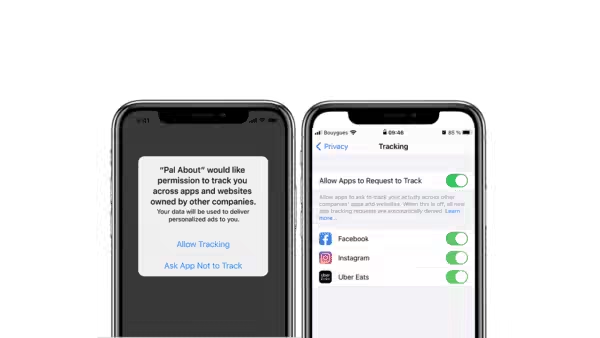
If you own an iPhone or iPad you may have noticed the update already. When you open Facebook, Instagram, Twitter or classified ad apps, a window appears in which the app explicitly asks your permission to track you in other providers’ apps and while browsing.
In that window the app operators may place a personalised message making clear why users should allow tracking. If apps can make their case credibly, there is nothing standing in the way of permission. However, many users’ trust in Facebook and others, and in how they handle personal data, tends to be low. That is a particular shame because the first to be affected are not the large social media companies but smaller businesses with smaller budgets, which depend on big data for personalised advertising.
Users are also free to forbid app tracking generally in the settings, in which case apps may not even ask. In Germany the central association of the advertising industry and the publishers’ associations joined forces to challenge this at the Federal Cartel Office. Whether Google will follow with a similar system for Android remains to be seen. That Apple can put privacy in the foreground far more credibly than Google, whose system is based on advertising and data, is not in dispute.
Facebook’s counter-argument and the changes in online marketing
Facebook in particular fought bitterly against switching off extended tracking, emphasising that smaller companies above all would suffer. While that argument is not wrong in substance, it is of course also up to Facebook to pass the available data on to smaller companies more effectively.
With Cambridge Analytica and the disinformation campaigns that followed, Facebook has shown more than clearly in recent years that the company is happy to blur the line between fair data use and data misuse — as long as it serves its own interest and keeps users on the platform for longer.
The data sets tracked by Facebook, Instagram or WhatsApp include location data, address, name, telephone number, device ID, user ID, contacts, search history and email address. This very precise picture of users is used above all to offer more relevant advertising, but it is also an intrusion into private data that many users are not aware of at all.
Patience with tracking and reporting
Monitoring and reporting are affected in real time. If you are used to seeing conversions immediately and attributing them to the right ads, you will need a little more patience in future.
That makes optimising campaigns across platforms harder and slower, but it might be a reason for you to rely more on the Facebook and Instagram shops, since that keeps all the data on one platform.
Work with broader audiences
Interest-based targeting is very strongly affected, because Facebook works with fewer data sets in future. For interests in particular that is a heavy loss, since they are often based on data from browsers and search engines.
In your settings you should therefore no longer define your audiences quite so narrowly, but start with a broader base. The social media algorithm can then sort things out by itself. It is no longer as lean and elegant as it once was, but ultimately it remains similarly functional.
Rethink and rework retargeting
You will miss the data most painfully in retargeting, since you cannot reach the visitors to your website on social media as quickly.
Put a stronger focus on lead generation on your own website and capture the contact details of interested visitors directly, without the detour through social media.
Create more quality on social media
The iOS 14 update is not the end of online marketing, even if Facebook would like to present it that way. A stop is being put to intrusive data collection, and in the long term that is in every user’s interest.
If you do your job properly and focus above all on high-quality content, you should hardly be affected. Advertising on social media will in future be one thing above all: more competitive. So do not shy away from the competition.