Inactive customers are untapped potential. What is meant here are customers who have not made a purchase for a long stretch — two or three years, say. If you manage to reactivate them, you lift your revenue.
This group is a particularly rewarding one, because these are people who have already bought from you in the past. Set against prospects who do not know you yet, the likelihood of a purchase is higher. Marketing automation is a promising route back to them.
When does a customer count as inactive?
How long a gap counts as inactivity depends on your product portfolio. A new car is needed less often than a new pair of shoes, so a car dealership has to work with a far longer window than a clothing retailer. If the dealership also does repairs, the window shortens again. You should assume that these customers have taken up an offer from a competitor in the meantime — reactivation is still possible.
“The advantages of your own offer and your special promotions have to be brought to the front, and they have to awaken a positive feeling.”
What is marketing automation?
Marketing automation covers the support and control of customer-related business processes on the communication side. Email marketing is one part of it, often combined with elements of social media marketing and the data held in your CRM system. Contact and conversation with the customer are then carried out through suitable technical systems and solutions.
Planning a win-back campaign that leads somewhere
Campaigns to reactivate inactive customers are there first of all to generate additional revenue. Ideally the reactivated customers do not stop at a single repeat purchase but return to being active customers over the long term. You will not win everybody back. That makes the campaign a measurement as well as a campaign: it shows you which customers are worth the effort.
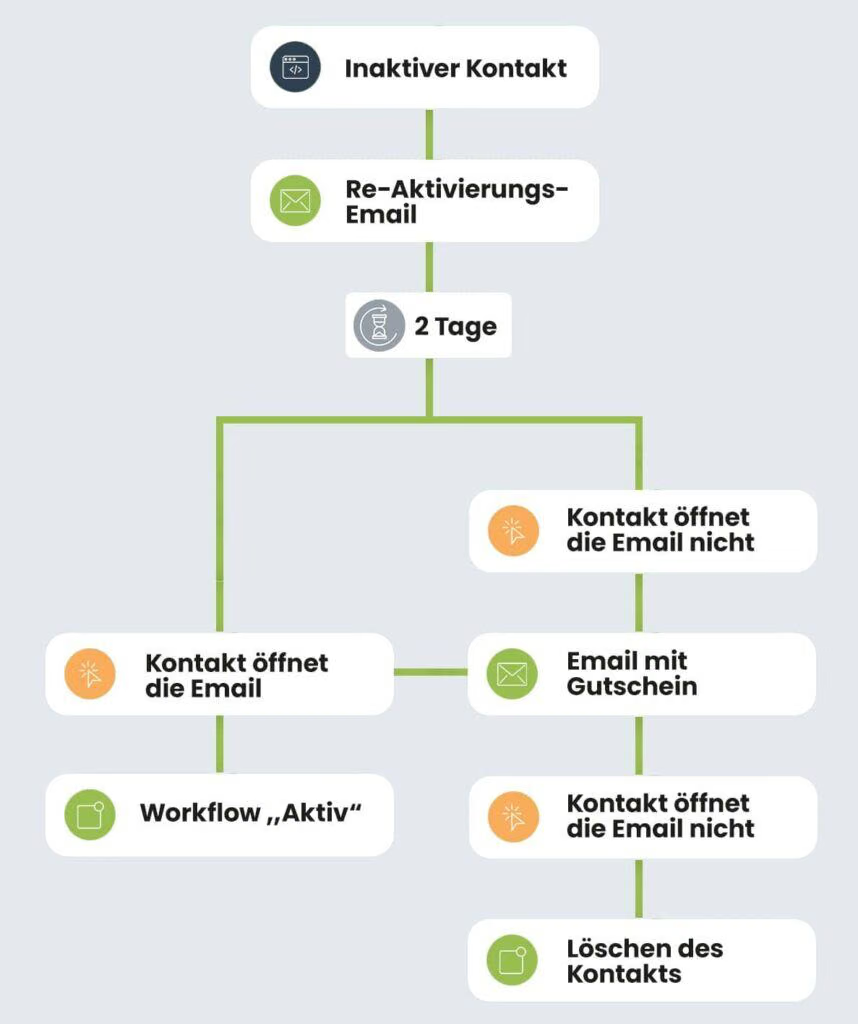
An example. You launch an email campaign and write specifically to inactive customers who are still subscribed to the newsletter, asking them to confirm that they want to keep receiving it. If a customer does not respond, the interest is evidently gone, and it is worth considering whether to keep sending to that address at all. Checking these signals systematically keeps your database clear, lean and structured, which is how you keep your marketing automation resources on the contacts that repay them. Even so, do not drop a subscriber too quickly. It is better to match what you send to how the subscriber behaves.
Should you stop the newsletter when a customer stays inactive?
That can only be answered in context. The address may simply be “dead” — an inbox nobody uses any more. Marketing automation tools show you whether a newsletter has been opened at all, and that is what separates a dead address from a subscriber who is still there but no longer reacting.
If somebody opens the newsletter but never interacts with it, they do not count as an inactive subscriber. In that case a change of content may be enough to get a reaction. Dead addresses, on the other hand, should not stay in your database: they inflate the total number of contacts and distort your email statistics.
Differences within the group of inactive customers
If people read the newsletter but do not buy, the chance of winning them back is high. Discounts and vouchers are the obvious tactic for this group.
“Once the system spots that a customer has not bought for a long time, that customer is moved into the reactivation campaign.”
The voucher code goes to the address held in the system. Keep the voucher valid for a limited period only: the incentive to react quickly is greater then, and the customer rates the voucher more highly. Discount promotions and gifts work as alternatives — you might announce, for instance, that every order above 20 euros comes with a surprise gift.
Do discounts and voucher campaigns work?
Studies show that people are willing to spend money in order to receive a free gift; the reward effect is strong. The gift does have to be enough of an incentive for the purchase, though. The better you know your audience, the more precisely you can match the gift to what your customers actually want. Marketing automation is where that audience analysis happens, on the data you collect in your CRM system.
“Age, gender, marital status and previous purchasing behaviour, among other things, tell you which gift a customer is likely to prefer.”
How often should you write to customers?
Write as often as required and as rarely as possible. A newsletter that arrives too often feels intrusive, and there is no reason left to open every one. Sent at wider intervals as part of a reactivation campaign, it does the opposite: it makes people curious again.
The company name and the brand name — and they belong in the sender field — are what catch the eye. They put you back in the mind of a customer who had gone quiet. Special events, seasons and celebrations are always worth a newsletter of their own. Is your company marking an anniversary? Is the Christmas season coming up? Or the start of summer?
“Newsletters can be made particularly effective when they are tied to an occasion.”
Five tips: how to run reactivation with marketing automation
- Define the point at which a customer counts as inactive.
- Design your reactivation campaigns for specific customer groups.
- Put newsletters and email marketing to work.
- Tie the campaigns to special occasions.
- Bring in professional support: Thorit GmbH specialises in connecting marketing and technology.
Reactivating inactive customers with marketing automation is a promising piece of work. With the right support behind it, it can be carried out in a targeted way and made to pay.