In the current Covid-19 pandemic, good crisis management is indispensable for companies. Why marketing strategies should also be adapted is obvious given the declining purchasing power of many customers. Here is why good crisis management correlates with your marketing strategies, and to what extent your company can benefit from the current situation.

Online business is wobbling too
The Covid-19 pandemic, with a complete shutdown in many sectors, is putting the economy at considerable risk. That applies not only to the parts of the economy that were primarily represented offline, but to online business as well. Although people are mostly at home at the moment and online trade ought therefore to be booming, only very few sectors are profiting from that boom. Why is that?
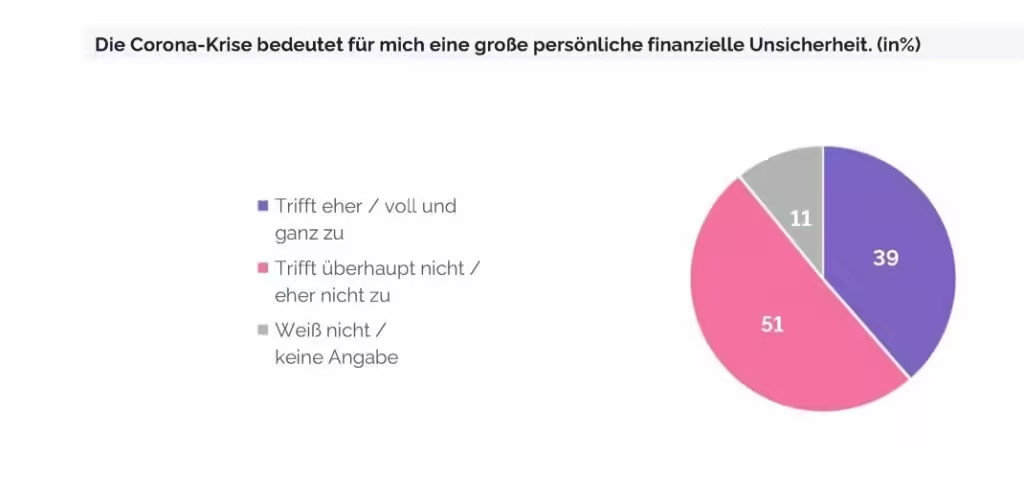
For one thing, most people have become more cautious in these times. Uncertainty about their own job and their own money makes purchases unattractive for many customers right now. But the marketing of many companies is off-putting too, because they have not adapted their strategies to current events and are first trying to stabilise the company through their crisis management.
That the two do not work without each other has not yet reached many companies. Stability also means that the familiar buying and ordering processes should continue wherever possible — and without the right marketing strategies, that is currently prevented.

Clear communication towards customers
Many companies are currently withdrawing into themselves and using their existing communication channels only rarely, or only with content created before the crisis. That is precisely the problem, because no customer can then tell how the company is actually doing.
Good crisis management always means bringing your own customers on board and asking for support for the company. To be clear, support does not mean a company has to beg customers for financial help. But good crisis management does mean explaining to customers how the company is doing, and by what means customers can express their support — through orders and purchases, for example.
What matters is that this crisis management is carried and supported by fitting marketing strategies, because the company’s messages can only be conveyed successfully to the relevant audience through marketing.
Clear strategies: honesty convinces the market
Since customers reward a company’s honesty, marketing strategies have to be found that convey exactly that honesty. It is important that a company does not appear as a supplicant but still comes across as strong and reliable to the customer.
However helpful it might be to ask customers for financial support, a request like that damages the brand considerably and can lead to a marked loss of trust. All of a company’s actions should therefore be honest but also positive, and should convey to customers that with their order or purchase they are actively supporting the company.
Further marketing strategies can be developed to strengthen the brand effect of the company even within crisis management. One example: for every purchase over 20 euros we donate 5 per cent of the order value to organisation XYZ.
As a company you benefit from a campaign like that several times over. On the one hand it can significantly increase the share of buyers and thus provide economic relief. On the other hand you strengthen the public image of your company. In current times, marketing strategies of this kind can even earn you a mention in national media and thereby increase your reach.
It is also a good signal to your own employees, since your company is looking not only at itself but at other people as well. That too can provide considerable relief within crisis management and increase the productivity of your own staff.
Marketing in a crisis: a shift in buyer interests
It is also important for many companies that in times of crisis the interests of buyers can shift noticeably. In entertainment that is already clearly perceptible. The clothing industry, too, is feeling a marked decline, as many customers do not want to spend money on new clothes at present.
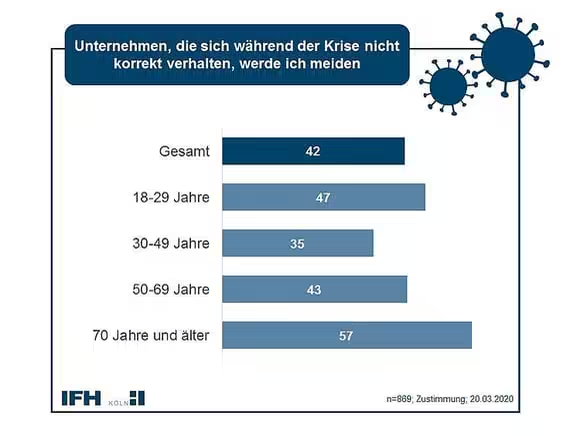
As a company it is particularly important in crisis management to take these points into account and to adapt your own marketing accordingly. People’s longings and wishes change in a situation like this as well. The task is to develop marketing strategies that pick up on those longings and use them effectively to create incentives to buy.
Keeping the future in view: addressing the buyer deliberately
A crisis never lasts forever and can therefore be overcome. That is not only the longing of people and customers but of companies too. Your marketing strategies should cover exactly that point effectively and think about what things will look like once the crisis is over. What will customers want after the restrictions? Which things will they buy, which will they need?
Align your marketing strategies with the parts of your portfolio that can be expected to serve people’s longings most closely, and which customers will most want after the crisis and the lockdown. You have to keep those strategies open enough, since an end to the crisis is not yet in sight, but they should still be concrete enough to awaken customers’ desire.
It is a balancing act you have to perform as an entrepreneur. But to secure the continued existence of the company, these marketing strategies are the right choice. At the latest with the first announcement of easing, you will benefit enormously from your forward-looking marketing.
Conclusion: good marketing strategies carry your company through the crisis
Targeted, well-structured marketing strategies are in every case part of good crisis management for companies, since they prepare the company for an end to the crisis and can give it support and structure.
Always think beyond the current crisis and try to put the needs of your customers and their wishes into focus. These marketing strategies pay off in the long term in every case, and ensure growth in customers as soon as the current crisis has been overcome.